
'It may seem
strange that a society which had institutionalized warfare should have undergone
a bloodless conversion. But it was so.'
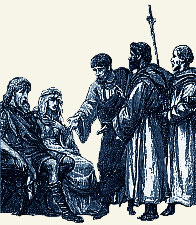
Augustine and
his fellow monks came to persuade and not to force a strange belief on the
Anglo-Saxons. A letter from Gregory the Great to Abbot Mellitus demonstrates
that the pagan culture should be assimilated into Christian belief as far
as possible, thus enabling the converted to adopt the new religion without
sacrificing their own cultural identity entirely.
'Tacitus writes
of the characteristic organization of Germanic men into warbands. The chief
was leader by virtue of his personal prowess, and he gathered men around him
not only by his reputation, but also by generous dispensing of the spoils
of war to his warriors. Every battle was not only a means of gaining spoils
and honour, but also a practical reinforcement of the loyalty between chief
and retainer. The renown attached to the chief, the chief rewarded his followers.' The loyalty of the retainer became the core of his existence. This social
code of the continental Germanic tribes, so predominant in Beowulf, was also
essential to Anglo-Saxon society. 'For them [the Anglo-Saxons], it was proverbial
that "death is better than a life of shame", the shame attaching
to anyone who ran away from battle, the shame of disloyalty.'
The loyalty of the retainer became the core of his existence. This social
code of the continental Germanic tribes, so predominant in Beowulf, was also
essential to Anglo-Saxon society. 'For them [the Anglo-Saxons], it was proverbial
that "death is better than a life of shame", the shame attaching
to anyone who ran away from battle, the shame of disloyalty.' But shame was not the worst that awaited the disloyal man. He would be cast
out, far from the mead-benches, leading a solitary life without any stability
or security left in a hostile world.
But shame was not the worst that awaited the disloyal man. He would be cast
out, far from the mead-benches, leading a solitary life without any stability
or security left in a hostile world.
The relation of ring-giver and retainer was easily transferred to that of God and the faithful Christian. Christ had given his blood and the believer paid him back by his loyalty. The believer was then in turn rewarded with eternal salvation. How far this adaptation of ideologies went can be seen in the following citation from the saint's life of Andreas, where his followers are asked to stay behind:
'Where shall we turn, lordless,
miserable, deprived of all that is good,
wounded with sin, if we desert you?
We would be hateful in every land,
despised among the people, when the brave
sons of men sit in counsel and discuss
which of them best and unfailingly supported
his lord in battle, when on the field of war
in the malicious play of fight, hand and shield,
eaten away by swords, endured hardship.'

On the other hand, the peaceful nature of the Christian doctrine, the idea of victory through sacrifice must have been difficult to grasp for a warrior society - a paradox that has been eloquently elaborated in the Dream of the Rood. The veneration of Edmund the Martyr, however, who stood up against his enemies but refused to fight and was barbarously killed, proves that the Anglo-Saxons came to terms with this controversy. The spiritual battle of such a man was respected just as much as the deeds of the hero on the worldly battlefield.
| The Mission | Christianisation through Persuasion | Why Christianity? |
| Paganism vs. Christianity |  |
|
