
'Death
is defined in the early Middle Ages with remarkable unanimity as the separation
of the body and soul. There is universal agreement about the fate of the
body between death and the last day: it is destroyed in the natural order
of things. Concerning the soul, however, there is considerable ambiguity.'
 :
works, words and thoughts. In some texts, however, repentance is enough,
as shown, for example, in Judgement
Day II. 'The thief was on the cross, guilty and sinful, With wrongdoings
all laden: He to the Lord, nevertheless, nigh unto death, His prayer bade
with heart-thoughts: He with few words, but full of faith, His
:
works, words and thoughts. In some texts, however, repentance is enough,
as shown, for example, in Judgement
Day II. 'The thief was on the cross, guilty and sinful, With wrongdoings
all laden: He to the Lord, nevertheless, nigh unto death, His prayer bade
with heart-thoughts: He with few words, but full of faith, His
salvation
obtained, and help speedily, And fared in at the peerless gates Of Paradise,
with the Redeemer (lines 57-64).'
There is
no uniform answer to the question of how long repentance remains effective
and penance possible. 'The view that humans awaited the resurrection in
a state of suspension or of sleep would be the strictly orthodox position.' Such a state would leave no room for penance between death and judgement.
Saints were spared this limbo and went directly to heaven to await there
the completion of their number, as described in Bede's
Explanatio
Such a state would leave no room for penance between death and judgement.
Saints were spared this limbo and went directly to heaven to await there
the completion of their number, as described in Bede's
Explanatio .
.
But the concepts
of an afterlife in Old English literature vary. 'It is generally agreed
by historians that the doctrine of purgatory was not fully developed until
at least a century after the time of Ælfric.' This opened the field for speculations and differing views.
The idea
of a cleansing fire that will purge a man from lesser sins had already
found a place in Anglo-Saxon thought. Next to being a sign of the Last
Days, the fire at Judgement was of different character depending on the
sinfulness of the individual, as described in Elene. 'The world
shall pass, and all people will be caught in the fire and burned - some
less, some more, some consigned to the fire forever. The upper two-thirds
shall be purged and shall then enter the kingdom of heaven.'
The
contrast in experience between the righteous and the sinful in the fire
parallels the diverging appearance of Christ to both groups either as
mild king or dreadful judge ,
while the great familiarity of this concept of the righteous in the fire
and Daniel 3 becomes especially visible when the bible is compared to
the relevant passage in The
Phoenix:
,
while the great familiarity of this concept of the righteous in the fire
and Daniel 3 becomes especially visible when the bible is compared to
the relevant passage in The
Phoenix:
| 25 He answered and said, Lo, I see four men loose, walking in the midst of the fire, and they have no hurt; and the form of the fourth is like the Son of God. | 518-521
There the bodies, clean from vices, will walk glad-hearted, and spirits
will return to their bony vessels while the holocaust mounts high
to the heavens . . |
On his journey through the afterlife, Dryhthelm is shown four places: heaven and hell, the purgatory and a field where those wait who have escaped the purgatory because of their behaviour in life, but are not yet worthy to enter the heavenly kingdom.
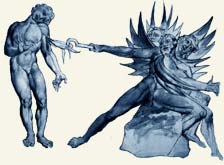
Three of these groups will enter the kingdom after Judgement. Only those in hell are damned forever.
Another path
to after-life salvation is available through the living .
Prayers (especially monastic ones) by righteous people and masses have
an effect on the fate of the dead. 'Some of them also, through aid of
friends and alms-deeds, and, above all, through holy masses, will be delivered
from those torments before the great doom.' (Alia
Visio)
.
Prayers (especially monastic ones) by righteous people and masses have
an effect on the fate of the dead. 'Some of them also, through aid of
friends and alms-deeds, and, above all, through holy masses, will be delivered
from those torments before the great doom.' (Alia
Visio)
Such concepts of a purgatory or of masses for the dead provided hope, but did not free man from his responsibility for his own salvation. Apocalyptic argumentation in Old English literature warned the people to live according to Christian doctrine and additionally to care for the salvation of those already dead.
The large amount of literature with apocalyptic content stands witness to the popularity of apocalyptic concepts and the effectiveness of the derived argumentation.
 |
Didactic Potential |
